At a Glance
Quick Product Summary
| Product Type |
Split-system wine cellar cooling system |
| Model |
S-WKBT-4000-220 |
| Condenser |
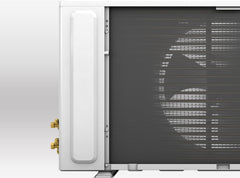
220V High Efficiency air-cooled condenser |
| Airflow Options |
Ducted, ductless, or hybrid configuration |
| Published Cellar Sizing |
Approximately 1,000 cu. ft. fully ducted or up to approximately 2,000 cu. ft. with deflectors, subject to a professional heat-load calculation |
| Published 85°F Performance Range |
Approximately 3,848 sensible BTU/h to 5,351 total BTU/h, depending on airflow configuration and fan speed |
| Controller |
KDT digital controller with 50-ft display cable and 50-ft liquid-temperature bottle probe |
| Refrigerant |
R-134a |
| Maximum Line-Set Distance |
Up to 100 lineal feet between the evaporator and condenser |
| Line Set Included |
No |
| Installation |
Certified HVAC-R installation required |
Buyer Fit
Who Is the Blow-Through 4000 H.E. 220V Best For?
The Blow-Through 4000 is intended for professionally planned projects where placement flexibility, hidden integration, and control over supply and return airflow are important.
- Custom residential wine cellars
- Glass-enclosed wine rooms
- Built-in wine walls and display cellars
- Wine cellar soffit installations
- Custom cabinetry and architectural millwork
- Restaurants, tasting rooms, and private clubs
- Hospitality and commercial wine displays
- Projects where visible through-the-wall equipment is undesirable
- Installations requiring flexible supply and return airflow directions
- Projects requiring an outdoor-capable H.E. condenser
Selection Guidance
Who Should Consider Another Cooling System?
This system may not be the best fit for:
- Do-it-yourself installations without a certified HVAC-R contractor
- Projects that do not have space for a separate evaporator and condenser
- Cellars without proper insulation, a continuous vapor barrier, and a sealed exterior-grade door
- Applications that require a simple through-the-wall, self-contained cooling unit
- Projects where the required refrigerant piping, drainage, electrical service, and communication wiring cannot be installed
- Installations without adequate service clearance around the evaporator and condenser
System Advantages
Key Features and Benefits
Hidden Cooling Integration
The Blow-Through Series is designed for concealed installations. The evaporator can be positioned within a soffit, cabinet, attic, ceiling cavity, adjacent room, or mechanical area so the wine collection remains the visual focus.
Ducted, Ductless, or Hybrid Airflow
The required airflow kit determines how supply and return air move between the evaporator and wine cellar. Duct plenums, directional deflectors, or a combination of both support a broad range of architectural layouts.
220V High Efficiency Condenser
The included H.E. condenser is engineered for efficient operation and broad ambient-temperature performance. When installed according to the owner’s manual, it is designed to operate in ambient conditions from approximately -20°F to 120°F.
Liquid-Temperature Bottle Probe
The standard KDT control system uses a bottle probe to measure liquid temperature rather than reacting only to short-term changes in cellar air temperature. This allows the system to respond more closely to the temperature of the stored wine.
Remote KDT Digital Display
The KDT display includes a 50-ft communication cable, allowing it to be installed in a convenient location away from the evaporator. The controller is preprogrammed for wine storage and provides system-status and Advanced System Protection alerts.
Built-In Condensate Pump
The evaporator includes an internal condensate pump to assist with moisture management. A correctly routed drain line is still required, and condensate drainage must be tested during startup.
Three-Speed Airflow Control
The Blow-Through 4000 evaporator includes low, medium, and high fan settings. Lower fan speeds can reduce sound output, while higher speeds increase airflow and available cooling capacity.
Service-Friendly Construction
Dual-side access, removable coil construction, external electrical connections, multiple refrigerant-line knockouts, and upward-facing flare fittings help simplify installation and future maintenance.
E-Coated Coils
The evaporator uses coated coils designed to support durability and performance in the cool, humid operating conditions associated with wine cellars.
Required Selection
Required Airflow Configuration Kit
One airflow configuration kit is required. The correct kit should be selected according to the evaporator location, cellar openings, supply-air route, return-air route, available ductwork, and overall cellar design.
| Configuration |
Included Components |
How It Works |
Best Application |
| Ducted Airflow Kit |
Two duct plenums |
Both supply and return air are routed through insulated ductwork. |
Maximum concealment or installations where the evaporator is separated from the cellar openings. |
| Ductless Airflow Kit |
Two directional airflow deflectors |
Supply and return air are directed from the evaporator without complete duct runs. |
Soffits, cabinetry, and concealed in-cellar installations where direct airflow is practical. |
| Hybrid Airflow Kit |
One duct plenum and one directional airflow deflector |
One side of the airflow path is ducted while the other side uses a deflector. |
Projects where only the supply or return side requires ductwork. |
Directional deflectors may be positioned to direct air toward the front, rear, or downward, depending on the selected supply-and-return arrangement.
Duct Design
Ducting Requirements and Best Practices
Correct duct sizing and unrestricted airflow are essential for cooling capacity, sound control, condensate management, system efficiency, and equipment life.
- Use 10-inch insulated supply and return ducting for the Blow-Through 4000.
- Use insulated ductwork with a complete exterior vapor barrier.
- Keep duct runs short, straight, fully extended, and properly supported.
- Avoid crushing, crimping, compressing, or reducing the duct’s internal diameter.
- Use sweep-style elbows where possible.
- Allow for an approximate loss of 13 CFM for each 90-degree bend.
- Use no more than two 90-degree bends on each duct run.
- Seal seams and connections with approved foil tape or duct mastic.
- Install the required return-air filter grille according to the owner’s manual.
- Keep registers clear of bottles, cases, wine racks, millwork, and other obstructions.
- Set the evaporator fan to the required speed for the installed duct arrangement.
Manufacturer guidance permits supply and return duct runs of up to approximately 25 feet each, with a combined maximum of approximately 50 feet. Actual performance depends on duct diameter, bends, register design, static pressure, insulation, and overall airflow resistance.
Airflow Openings
Register and Louver Airflow Requirements
Decorative registers and custom wooden grilles must provide adequate free-air area. Restrictive openings can reduce cooling capacity, increase airflow noise, create excessive static pressure, contribute to evaporator-coil freezing, and shorten system life.
- Registers and louvers should provide approximately 50% to 65% free-air area across the total face.
- Avoid tightly spaced slats that reduce the required opening area.
- Do not use acoustic foam, restrictive mesh, screens, or solid backing materials.
- Account for the effect of stain, paint, sealant, and finishing materials on the finished slot dimensions.
- Verify the final free-air percentage before fabrication and installation.
- Maintain consistent openings across the full register face.
Airflow warning: Customer-supplied registers or louvers that do not meet the manufacturer’s free-air requirements may reduce performance and affect warranty eligibility.
Control Options
KDT Bottle-Probe Controller or 24V Thermostat Conversion
The standard system is supplied with the WhisperKOOL KDT controller and liquid-temperature bottle probe. An optional 24V Thermostat Conversion Kit is available for installations that require a customer-supplied third-party thermostat.
| Feature |
Standard KDT Controller |
24V Thermostat Conversion |
| Temperature measurement |
Liquid temperature through the bottle probe |
Ambient air temperature at the thermostat |
| Controller supplied |
Yes |
No; customer supplies the thermostat |
| 50-ft bottle probe |
Yes |
No |
| 50-ft KDT display cable |
Yes |
No |
| Evaporator monitoring |
Yes |
Not provided through the third-party thermostat |
| Automatic defrost control |
Yes |
Not provided through the third-party thermostat |
| Wine-temperature protection alerts |
Yes |
Not provided through the third-party thermostat |
| Preprogrammed for wine storage |
Yes |
No |
| Third-party smart-home compatibility |
No |
Dependent on the customer-supplied thermostat |
| Remote app features |
No |
Dependent on the customer-supplied thermostat |
| WhisperKOOL support for controller |
Yes |
WhisperKOOL does not provide technical support for third-party thermostats |
Important 24V thermostat notice: WhisperKOOL does not supply the third-party thermostat. Selecting the 24V Thermostat Conversion Kit means the system will not be built with the standard KDT controller, KDT display cable, or liquid-temperature bottle probe. The customer must source a compatible thermostat.
Sizing Guidance
Wine Cellar Sizing Guidance
Manufacturer cellar-size ratings assume a properly constructed and sealed enclosure with complete insulation, an effective vapor barrier, a sealed exterior-grade door, and controlled heat infiltration.
-
Deflector configuration: published for approximately 2,000 cu. ft.
-
Fully ducted configuration: published for approximately 1,000 cu. ft.
These figures are general selection guidelines and are not substitutes for a professional heat-load calculation. Glass, stone, concrete, exterior walls, windows, ceilings, lighting, door traffic, ambient temperature, duct losses, and inadequate insulation can substantially increase the required cooling capacity.
Undersizing may prevent the cellar from reaching the intended temperature and can contribute to excessive run time, operational problems, or premature equipment failure.
Cellar Preparation
Wine Cellar Construction Requirements
Insulation
The wine cellar walls and ceiling must be insulated. WhisperKOOL identifies R-13 as a recommended minimum, R-19 as preferred for interior cellar walls, and R-30 for ceilings and exterior walls.
Vapor Barrier
A continuous vapor barrier is required to reduce moisture migration into the cooled enclosure. Cuts, overlaps, conduit openings, wiring penetrations, and other breaks must be completely sealed.
Cellar Door
Use an exterior-grade door with weather stripping on all sides and a sealed threshold or bottom sweep. Air leakage around the cellar door is a common cause of excessive system operation.
Glass-Enclosed Cellars
Glass has a lower insulation value than a conventional insulated wall. Glass-intensive cellars require a detailed heat-load calculation and may require more cooling capacity than an insulated room of similar volume.
Evaporator Insulation
The supplied exterior insulation blanket must be installed before the evaporator is mounted. Evaporators placed in soffits, attics, ceiling cavities, or warm adjacent spaces also require additional fiberglass insulation rated R-19 or higher around the exterior surfaces, as directed in the owner’s manual.
Condenser Overview
220V High Efficiency Condenser
The 220V H.E. condenser is designed for installations requiring efficient performance, reduced operating sound, straightforward service access, and operation across a broad ambient-temperature range.
- 220V electrical configuration
- Approximately 0.6 HP compressor
- Engineered ambient operating range of approximately -20°F to 120°F
- Sound level published as low as approximately 48 dBA at 6 ft.
- May be installed up to 100 lineal feet from the evaporator
- Designed for outdoor installation when installed according to the owner’s manual
OMEGA condenser exterior enclosures and OMEGA indoor ducting kits are intended specifically for OMEGA condenser configurations. They are not required for the 220V H.E. condenser included with this model.
Professional Installation
Installation Requirements
- Installation must be completed by a qualified, certified HVAC-R technician.
- Verify evaporator and condenser voltage against the equipment labels before installation.
- A dedicated 15-amp circuit is required for the applicable components.
- Do not use a GFI outlet or GFI breaker where prohibited by the manufacturer’s instructions.
- Use a surge protector where recommended.
- Run an 18-5 thermostat wire communication cable between the evaporator and condenser.
- The refrigerant line set is not included.
- Size the line set according to total distance and vertical rise.
- Fully insulate and seal the suction line.
- Install and test the condensate drain line.
- Mount the evaporator level on a structurally adequate platform.
- Maintain at least 12 inches of front service-panel clearance.
- Maintain adequate airflow and service clearance around the evaporator and condenser.
- Complete and submit the split-system warranty checklist after commissioning.
Refrigerant Piping
Refrigerant Line-Set Requirements
The refrigerant line set is not included with the system.
| Maximum Distance |
Up to 100 lineal feet between the evaporator and condenser |
| Liquid Line |
1/4-inch OD |
| Suction Line, Less Than 50 ft. |
1/2-inch OD |
| Suction Line, Greater Than 50 ft. |
5/8-inch OD |
| Refrigerant |
R-134a |
| Connections |
Flared refrigerant connections |
Pressure testing, nitrogen flow, evacuation, leak testing, refrigerant charging, TXV adjustment, superheat, subcooling, voltage, amperage, and startup measurements must be completed and recorded by the installing HVAC-R technician.
Technical Data
Technical Specifications
| Brand |
WhisperKOOL |
| Product |
Blow-Through 4000 H.E. 220V Split Wine Cellar Cooling System |
| Model / SKU |
S-WKBT-4000-220 |
| System Configuration |
Split-system evaporator and air-cooled condensing unit |
| Airflow Configuration |
Ducted, ductless, or hybrid; required airflow kit selected separately |
| Published Cellar Size, Deflector |
Approximately 2,000 cu. ft. under qualifying cellar conditions |
| Published Cellar Size, Fully Ducted |
Approximately 1,000 cu. ft. under qualifying cellar conditions |
| Evaporator Voltage |
220V model configuration; verify equipment label before installation |
| Condenser Voltage |
210V–230V |
| Dedicated Circuit |
15 amps |
| Evaporator Running Amps |
Approximately 1.4 amps in deflector configuration; approximately 2.2 amps in fully ducted configuration |
| Condenser Electrical Ratings |
LRA 10.7 amps; RLA 2.7 amps; FLA 3.1 amps |
| Condenser Horsepower |
0.6 HP |
| Refrigerant |
R-134a |
| Evaporator Dimensions, Deflector Configuration |
Approximately 35.75 in. L × 14.125 in. W × 12.75 in. H |
| Evaporator Dimensions, Fully Ducted Configuration |
Approximately 22.1 in. L × 22.5 in. W × 15.5 in. H |
| Condenser Dimensions |
Approximately 31.18 in. L × 10.75 in. W × 21.18 in. H |
| Evaporator Weight |
Approximately 45 lbs |
| Condenser Weight |
Approximately 55 lbs |
| Fan Speeds |
Low, medium, and high |
| Evaporator Airflow |
Approximately 262 CFM low, 352 CFM medium, and 430 CFM high |
| Evaporator Sound Level |
As low as approximately 46 dBA low, 53 dBA medium, and 59 dBA high at 6 ft. |
| Condenser Sound Level |
As low as approximately 48 dBA at 6 ft. |
| Duct Diameter |
10-inch supply and 10-inch return |
| Maximum Refrigerant Line Distance |
100 lineal feet |
| Liquid Line |
1/4-inch OD |
| Suction Line |
1/2-inch OD under 50 ft.; 5/8-inch OD over 50 ft. |
| Condensate Management |
Built-in condensate pump with drain connection |
| Standard Controller |
KDT digital display with 50-ft cable and 50-ft liquid-temperature bottle probe |
| Temperature Setting Range |
Approximately 50°F–70°F |
| Target Cellar Condition |
Designed to maintain approximately 55°F under qualifying design and ambient conditions |
| Condenser Ambient Range |
Approximately -20°F to 120°F |
| Line Set Included |
No |
| Installation |
Certified HVAC-R technician required |
| Warranty |
Limited two-year parts-and-labor warranty, subject to installation, registration, checklist approval, operation, and maintenance requirements |
Specifications are configuration-dependent and may be revised by the manufacturer. The installer must confirm all dimensions, ratings, voltage requirements, airflow requirements, line-set sizing, and installation details against the current equipment labels and official owner’s manual.
Required Configuration
Required Selection
Select one compatible airflow configuration kit:
-
Ducted Airflow Kit: two duct plenums
-
Ductless Airflow Kit: two directional airflow deflectors
-
Hybrid Airflow Kit: one duct plenum and one directional airflow deflector
System Options
Optional Add-Ons
24V Thermostat Conversion Kit
Converts the system from the standard KDT bottle-probe control configuration to operation with a customer-supplied compatible 24V thermostat. Selecting this option removes the standard KDT controller, KDT display cable, and bottle probe from the system configuration.
Package Contents
What Is Included?
A complete configured system purchase generally includes the Blow-Through evaporator, 220V H.E. condenser, selected airflow components, insulation components, installation hardware, drain fittings, documentation, and the selected controller package.
With the standard KDT controller configuration, identified components include:
- Blow-Through 4000 evaporator
- 220V High Efficiency condenser
- Selected airflow kit components
- Evaporator insulation components
- Installation hardware
- Drain fittings and plugs
- KDT digital display
- 50-ft KDT display cable
- 50-ft stainless-steel bottle probe
- Wall-mount and flush-mount controller hardware
- Owner’s manual
- Split-system warranty checklist
Not included: Refrigerant line set and third-party smart thermostat.
Ongoing Care
Annual Preventative Maintenance
Annual preventative maintenance is important for dependable performance, warranty compliance, and a reduced risk of unscheduled wine cellar downtime. Refrigeration and electrical service should be performed by qualified personnel.
- Inspect insulated ductwork and vapor-barrier integrity.
- Clean supply and return registers.
- Clean or replace applicable air filters.
- Inspect and clean evaporator and condenser coils.
- Check coils and refrigerant connections for leaks.
- Inspect the condensate pan, pump reservoir, water sensor, and drain line.
- Perform a condensate drainage test.
- Inspect and tighten electrical connections.
- Inspect contactors and relays.
- Confirm fan operation.
- Measure operating voltage and amperage.
- Check refrigerant pressures, superheat, and subcooling.
- Inspect the sight glass and moisture indicator.
- Check controller probes.
- Clean the bottle probe and replace the water inside the probe bottle.
Warranty
Product Warranty
WhisperKOOL identifies a limited two-year parts-and-labor warranty for qualifying split systems, subject to the manufacturer’s installation, registration, operation, and maintenance requirements.
The split-system warranty is not activated until the completed warranty checklist has been received, reviewed, and approved by WhisperKOOL.
The checklist requires information such as:
- Installer name, company, and contact information
- Equipment model and serial numbers
- Line-set length, diameter, and vertical rise
- Pressure and temperature readings
- Superheat and subcooling measurements
- Refrigerant charge weight
- Operating voltage and amperage
- Condensate drain test results
- System startup date
Installation by an unqualified technician, restricted airflow, improper wine cellar construction, inadequate insulation, incorrect electrical supply, missing maintenance, or failure to follow the owner’s manual may affect warranty coverage.
Official Documentation
Product Resources and Downloads
Product Information
Installation and Configuration
Airflow and Ducting
Controls and Refrigeration
Maintenance
Professional Guidance
Professional Buying Guidance
The WhisperKOOL Blow-Through 4000 H.E. 220V is a strong choice for a professionally designed wine cellar where the evaporator must remain concealed and the project requires control over supply and return airflow.
Before ordering, confirm the required airflow kit, calculated heat load, available electrical service, condenser location, refrigerant line-set route, evaporator mounting space, service clearance, duct layout, register free-air area, drain routing, and preferred controller configuration.
Wine Coolers Empire offers free professional wine cellar design planning to help identify an appropriate product configuration for your project. Final refrigeration sizing, electrical work, duct design, and system installation must be verified and completed by qualified project professionals.
Common Questions
Frequently Asked Questions
What is the WhisperKOOL Blow-Through 4000 H.E. 220V?
It is a split wine cellar cooling system consisting of a concealed Blow-Through 4000 evaporator and a 220V High Efficiency air-cooled condenser. It supports ducted, ductless, and hybrid airflow configurations.
What size wine cellar can the Blow-Through 4000 cool?
WhisperKOOL publishes an approximate rating of 2,000 cu. ft. for a deflector configuration and approximately 1,000 cu. ft. for a fully ducted configuration. These ratings assume a properly insulated and sealed cellar with a complete vapor barrier. A professional heat-load calculation is required for accurate selection.
Why is the fully ducted cellar rating lower?
Ductwork introduces airflow resistance and potential thermal losses. Duct length, bends, insulation, register design, static pressure, and installation quality can reduce the effective cooling delivered to the cellar.
Which airflow kit is required?
Every system requires one airflow kit. Choose the ducted kit for two duct plenums, the ductless kit for two directional deflectors, or the hybrid kit for one duct plenum and one deflector.
Can the evaporator be hidden?
Yes. The Blow-Through evaporator is designed for concealed placement in soffits, cabinetry, wine walls, attics, ceiling cavities, adjacent mechanical spaces, and similar locations. Proper insulation, structural support, drainage, service access, and airflow must be provided.
Can the 220V H.E. condenser be installed outdoors?
Yes. The 220V H.E. condenser is designed for outdoor operation when installed according to the owner’s manual. Its published ambient operating range is approximately -20°F to 120°F.
Does the system include a refrigerant line set?
No. The refrigerant line set must be supplied, sized, and installed by the HVAC-R contractor. Required suction-line diameter depends on the total line-set length.
How far can the condenser be installed from the evaporator?
The manufacturer permits up to 100 lineal feet between the evaporator and condenser when the line set is correctly sized, installed, evacuated, charged, and commissioned.
Is a communication cable required?
Yes. An 18-5 thermostat wire communication cable must be installed between the evaporator and the 220V H.E. condenser according to the wiring instructions.
What does the bottle probe measure?
The standard KDT bottle probe measures the temperature of liquid inside a water-filled wine bottle. This allows the controller to respond to liquid temperature rather than short-term cellar-air fluctuations.
Can I use a smart thermostat?
A compatible customer-supplied smart thermostat may be used only when the system is configured with the 24V Thermostat Conversion Kit. WhisperKOOL does not supply or provide technical support for the third-party thermostat.
What is removed when the 24V Thermostat Conversion Kit is selected?
The system will not be built with the standard WhisperKOOL KDT controller, KDT display cable, or liquid-temperature bottle probe. The customer must supply a compatible 24V thermostat.
Does the system include a condensate pump?
Yes. The evaporator includes an internal condensate pump. A properly installed drain line and successful condensate drainage test are still required.
What duct size is required?
The Blow-Through 4000 uses 10-inch insulated supply ducting and 10-inch insulated return ducting.
Can decorative wooden grilles be used?
Yes, provided they meet the manufacturer’s airflow requirements. Registers and grilles should provide approximately 50% to 65% free-air area and must not use restrictive mesh, screens, foam, or solid backing.
Does the evaporator require exterior insulation?
Yes. The supplied insulation blanket must be installed before mounting. Additional R-19 or higher fiberglass insulation is required around evaporators installed in warm soffits, attics, ceiling cavities, or adjacent spaces, as directed in the owner’s manual.
Who can install the system?
A qualified, certified HVAC-R technician must install and commission the system. Refrigerant charging, pressure testing, evacuation, leak testing, TXV adjustment, electrical work, airflow verification, and warranty documentation require professional completion.
How is the warranty activated?
The installing technician must complete and submit the split-system warranty checklist. Warranty coverage is not activated until the checklist has been received, reviewed, and approved by WhisperKOOL.
What maintenance is required?
Annual preventative maintenance should include cleaning coils and registers, inspecting ductwork and insulation, checking refrigerant performance, testing the condensate system, inspecting electrical connections, checking fan operation, and cleaning the bottle probe.